
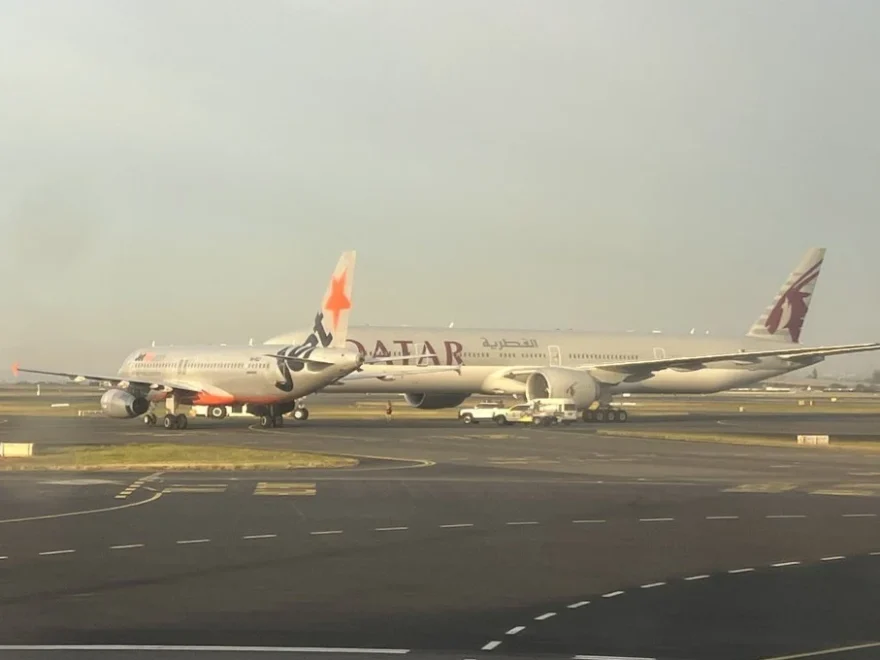
An emergency braking maneuver that could have turned into a tragedy
Sydney Airport was the scene this past weekend, August 9, 2026, of an incident that serves as a stark reminder of just how critical the ground taxiing phase remains in commercial aviation. A Jetstar Airbus A320, taxiing to the runway for a flight to the Gold Coast, had to brake sharply when its crew spotted a Qatar Airways Boeing 777 being towed on an adjacent taxiway.
The two aircraft came dangerously close to each other at a taxiway intersection. The Jetstar pilot, fearing that the wingtip might strike the nose of the Qatar Airways long-haul aircraft as it began to turn, applied the brakes with such force that a cabin crew member present at the time was thrown and fractured their hand. The crew member was treated by emergency services as soon as the aircraft came to a stop.
According to initial findings, the tractor towing the Boeing 777 may have disregarded instructions from air traffic control, which had ordered a complete stop. This hypothesis, which is still to be confirmed, is at the heart of the investigation launched by the Australian Transport Safety Bureau (ATSB), which stated that it is collecting recordings of communications with the control tower as well as statements from the crews and operators of the tow tractor. Investigators have also issued an appeal for witnesses among passengers and employees present at the scene, hoping to obtain video footage of the incident.
The incident also caused cascading delays to the rest of the airport’s traffic, with Airservices Australia confirming disruptions to ground operations in the hours that followed.
A far from isolated phenomenon
While this incident fortunately resulted in only one minor injury, it reflects a trend confirmed by official figures: runway incursions and near-collisions at airports are steadily increasing, in Australia as elsewhere in the world.
The ATSB itself recorded more than 1,100 reported runway incursions at Australian controlled aerodromes between July 2003 and January 2025, a figure that illustrates the scale of the problem even in a country where air traffic remains significantly lower than in the United States. Sydney is no stranger to such incidents: as early as July 1998, a Boeing 737 and a twin-engine Metro III narrowly avoided a collision at the intersection of Juliet Lane and Runway 34L. More recently, in 2022, a Boeing 737 came within just 300 meters of an A380 still on the runway at the time of its takeoff, a gap deemed sufficiently concerning to trigger a thorough investigation despite the investments made in recent years to improve ground handling safety at the airport.
The very configuration of Sydney Airport, with its three runways, two parallel and a third perpendicular one extending over Botany Bay, requires almost all aircraft to cross at least one active runway during their ground movements, which inevitably increases the opportunities for human error or communication breakdowns.
This situation extends far beyond the Australian case alone. In the United States, the Federal Aviation Administration has for several years considered runway incursions to be the country’s primary aviation safety risk, with approximately 230 incidents per year. At the beginning of 2023, the first two months of the year alone saw seven incursions involving commercial flights, the highest rate recorded in five years, prompting the administration to launch a national safety review. More recently, a study of incidents recorded by the National Transportation Safety Board between January 2024 and March 2025 counted 1,208 aviation safety events in the United States, including about sixty directly involving commercial flights, half of which resulted in injuries on board.
Other recent examples support this observation, including those in Australia. On July 12, 2025, a Qantas flight from Sydney to Johannesburg was delayed by nearly 24 hours after a boarding bridge struck one of the engines of an Airbus A380. While the incident resulted in no injuries, it highlighted the numerous points of friction that exist between fixed infrastructure and maneuvering aircraft. A little earlier, in August 2013, a Virgin Australia Boeing 737 reversing into the air struck an empty Jetstar A320 on the tarmac in Melbourne, damaging both aircraft but causing no injuries.