
Between standard economy, often considered too cramped on long-haul flights to Australia, and business class, whose price can sometimes be a deterrent, Qantas has been offering a third option for several years: Premium Economy. It’s neither a simple elevated economy seat nor a budget “mini-Business” class, but a full-fledged cabin designed for flights lasting 13 to 17 hours connecting Australia to Europe, North America, or Asia.
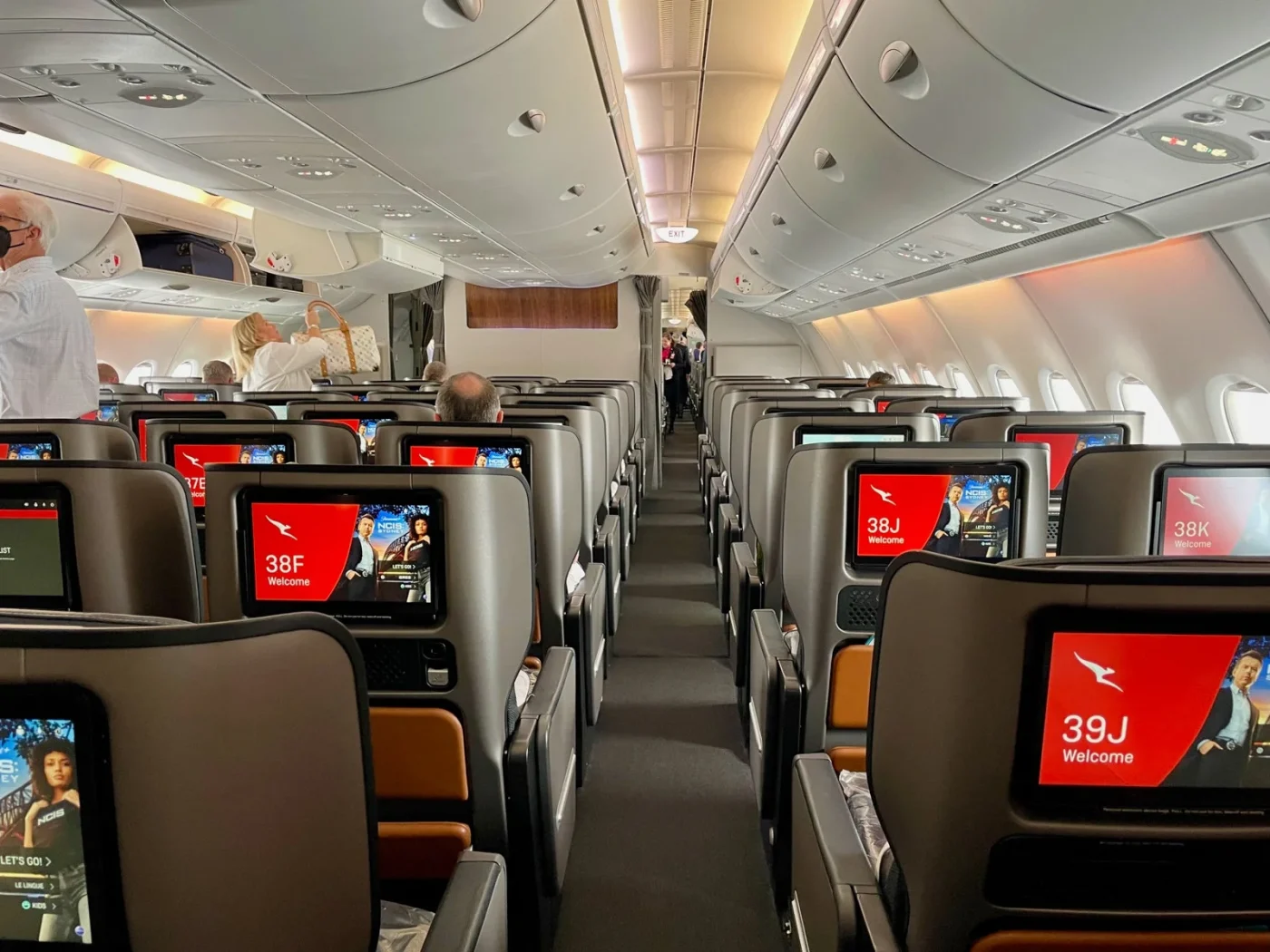
A dedicated cabin, not just “Economy Plus”
Unlike some airlines that simply widen the first few rows of economy class, Qantas physically separates its Premium Economy into a distinct cabin, complete with its own crew and service. On the Airbus A380, it occupies the upper deck, just behind Business Class, with a 2-3-2 configuration. On the Boeing 787-9 Dreamliner, which operates ultra-long-haul routes to London and North America, the cabin is slightly more compact, but the seats are actually a bit wider than on the A380.
The number of seats is intentionally limited: around 35 to 40 seats depending on the aircraft, compared to several hundred in Economy Class.
Premium Economy seats: the real selling point
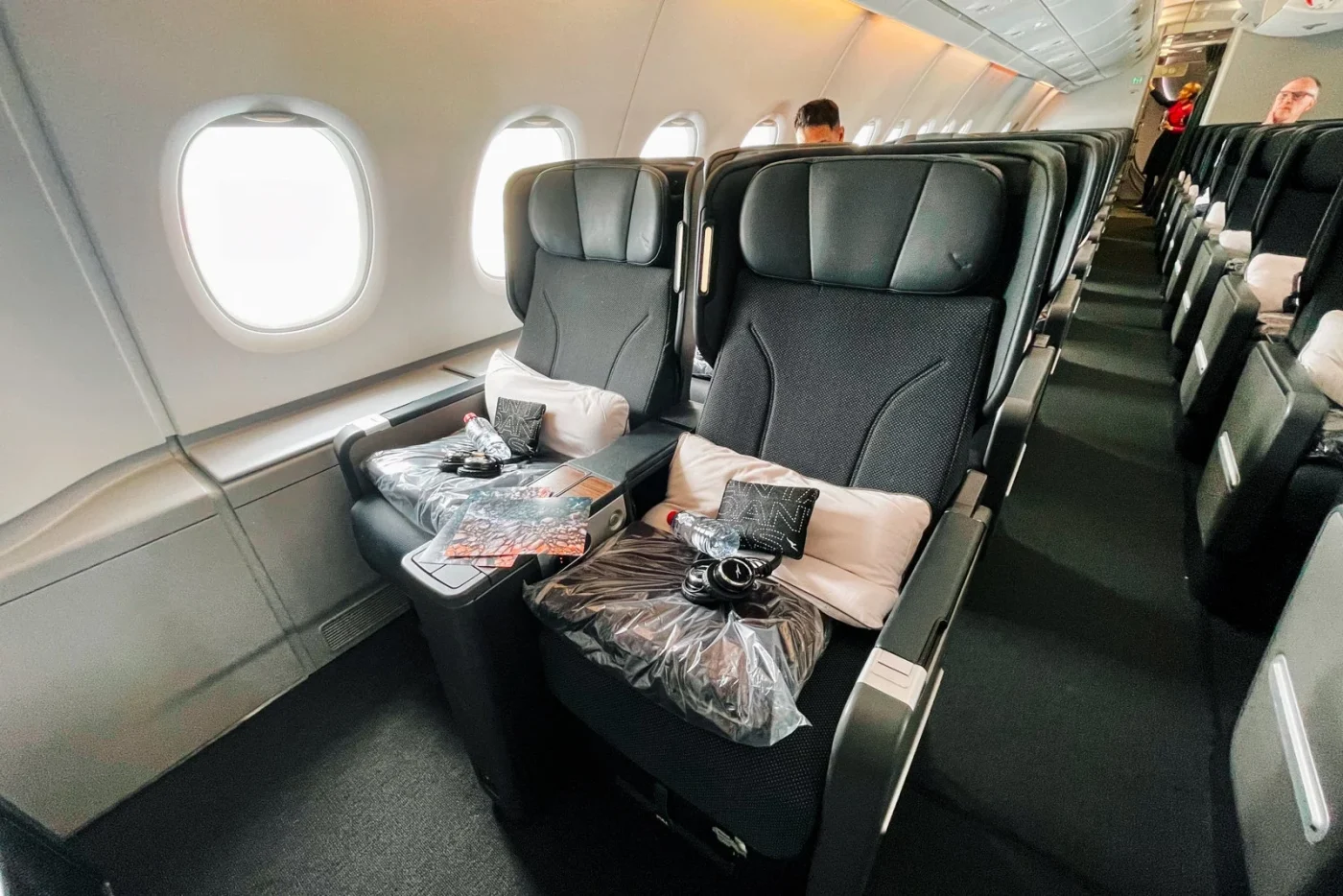
The point that comes up most often in passenger feedback is legroom. Qantas advertises a pitch (the space between two rows) of up to about 42 inches, compared to 31 to 32 inches in standard economy, and a seat width of nearly 19.5 inches. In practical terms, this allows passengers to stretch their legs without touching the back of the seat in front—a detail that makes a big difference on a Melbourne-to-Los Angeles flight or on the direct London-to-Perth route, one of the world’s longest nonstop flights by distance.
The seat also features an electrically adjustable leg rest and a retractable footrest, allowing passengers to assume a semi-reclined position that is far more comfortable than in economy class. The rigid shell, designed by Australian designer David Caon, limits the impact of the passenger in front reclining their seat: when they recline, the space for the passenger behind is not reduced in the same way as in a conventional cabin.
One frequently criticized issue is the reclining mechanism. On some older models, returning the seat to an upright position requires pressing a button while in a slightly uncomfortable position, and several passengers have reported needing assistance from the flight crew to do so without straining.
In-Flight dining and service
This is often the second most frequently cited factor for passenger satisfaction. The Premium Economy service is similar to a restaurant-style experience: a more carefully presented tray, a choice of three main courses instead of two in Economy, higher-quality tableware, and a menu that highlights Australian products. Service is generally provided by a crew dedicated to this cabin, resulting in a less rushed pace of service.
Baggage, check-in, and lounge access
Unlike many competing airlines, Qantas includes a generous baggage allowance in its Premium Economy fare: typically two checked bags weighing up to approximately 32 kg each, as well as two carry-on bags. Seat selection is free at the time of booking, which avoids the unpleasant surprise of being assigned a seat at the last minute.
However, one thing often surprises travelers experiencing this class for the first time: Premium Economy does not automatically grant access to airport lounges. Unless the passenger is already a Qantas Club member or has a high enough Frequent Flyer status, they must wait in the standard boarding area, which contrasts with the “door-to-door” experience one might expect at this price point.
In-flight entertainment and connectivity

The individual screens in Premium Economy are larger than those in Economy, with a movie selection identical to that offered in Business Class on most aircraft. In-flight Wi-Fi, which was long absent or limited on certain Qantas long-haul routes, has gradually become standard across the fleet, but its availability and quality still vary depending on the aircraft and route: it’s best to check at the time of booking rather than relying on reviews from a few years ago.
How much does Qantas Premium Economy cost?
The fare depends heavily on the route, the season, and how far in advance you book. As a general rule, expect to pay between double and triple the price of an Economy ticket on the same route, while still being significantly less than a Business ticket, where the price difference can be three to four times higher than that of Premium Economy itself. On routes between Australia and the United States, or on the direct flight to London via Perth, promotional Premium Economy tickets often sell out several months in advance, before the best fares disappear.
Purchasing through loyalty programs (Qantas Frequent Flyer, as well as oneworld alliance partners such as American Airlines AAdvantage or British Airways Executive Club) sometimes allows you to book this class for a very reasonable number of miles compared to Business Class.
Premium Economy, Economy, or Business: How to Choose?
Qantas Economy Class remains a good option for short flights or tight budgets, even if it means accepting more limited comfort on very long-haul flights.
Premium Economy is primarily designed for flights longer than 10 hours, when sleep and recovery upon arrival become a real concern, without having to pay the price of a fully flat bed.
Business Class retains the advantage of a fully reclining seat, essential for getting a good night’s sleep, but at a price that may deter many leisure travelers.
Many frequent travelers on the Australia-Europe or Australia-North America routes adopt a hybrid strategy: Business Class on the outbound flight to arrive well-rested, Premium Economy on the return flight, or vice versa, depending on flight schedules and the impact of jet lag.
Our practical tips before booking
Choose a seat in the first row (bulkhead) if possible: it offers extra legroom and ensures that no passenger reclines in front of you. These seats are often made available 48 hours before departure, once priority has been given to families and high-status passengers.
Check the aircraft type for your chosen route: comfort isn’t exactly the same across the A380, 787-9, and A330, particularly in terms of seat width and Wi-Fi availability.
Book early during peak travel periods (school breaks, the end-of-year holidays, etc.), as the number of Premium Economy seats is limited and the best fares sell out quickly.
Don’t count on lounge access unless you have sufficient loyalty status: plan for a wait in the standard boarding area.
Compare the cost in miles and cash before deciding, as on certain routes, the price difference in cash between Premium Economy and Business Class can sometimes be surprisingly large during periods of high demand.