
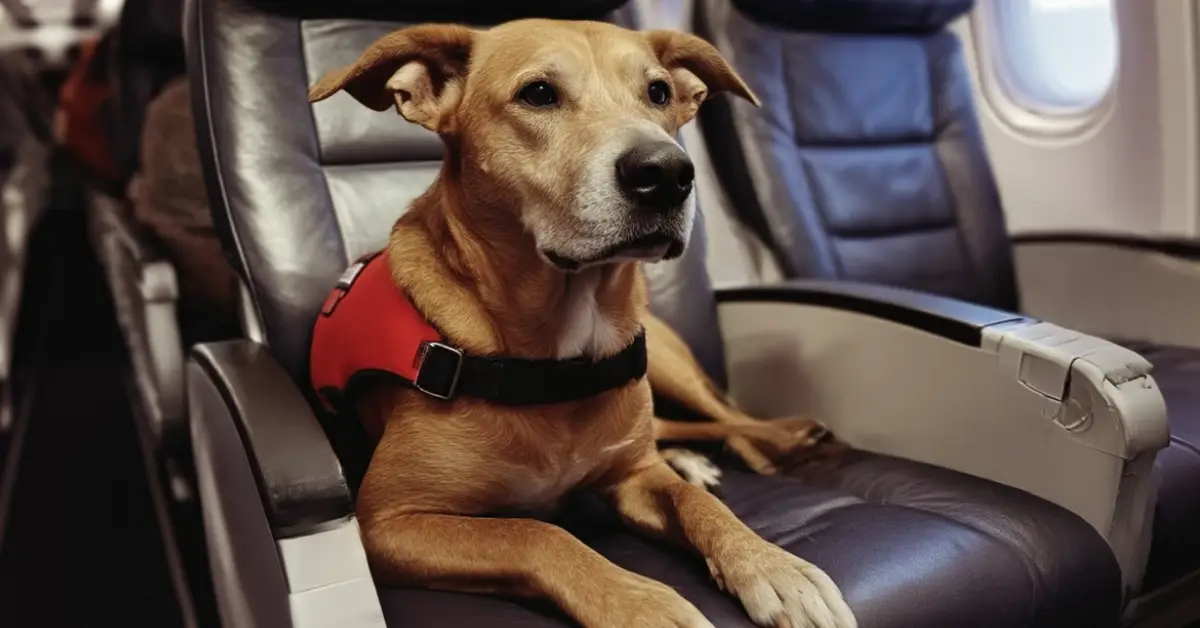
Traveling with a service dog always raises a number of questions, especially when planning a flight to Australia. Virgin Australia, one of the country’s major airlines, has established a specific framework to accommodate passengers with disabilities accompanied by their guide, hearing, or service dogs. This guide outlines all the rules you need to know before booking.
A policy distinct from the Pet Program
It’s essential not to confuse two very different programs at Virgin Australia. On the one hand, the Australian airline has launched a paid program allowing small dogs and cats to travel in the cabin on certain domestic routes, subject to restrictions on weight, carrier size, and dedicated seats. On the other hand, there is a completely separate, older, and much more flexible policy reserved for genuine service dogs. These dogs are not subject to the fees, weight limits, or size restrictions imposed on regular pets. → View Virgin Australia’s restrictions on pets in the cabin.
Who is considered a service dog?
Virgin Australia recognizes several categories of animals under the general term “Service Dog”:
– Guide dogs, which accompany people who are visually impaired or blind;
– Hearing dogs, trained to assist people who are deaf or hard of hearing;
– Assistance dogs in the broad sense, which help people with disabilities other than visual or hearing impairments (limited mobility, neurological disorders, etc.).
Guide dogs and hearing dogs have special legal status in Australia: they may accompany their handlers into virtually all public places, provided they present valid accreditation.
Specific requirements on board:
For an assistance dog to be allowed in the cabin, several practical requirements must be met. The animal must wear a harness as well as a clearly recognizable identification vest or jacket. It must remain on the floor at its owner’s feet, without ever obstructing the aisles or emergency exits, so as not to hinder a potential evacuation. An absorbent mat, provided by the owner, must be placed under the animal for the duration of the flight.
The number of service dogs is also limited: a maximum of two animals are allowed per flight, whether on domestic routes or short-haul international flights.
Training and certification:
Regarding assistance dog training organizations, the guidelines published by Virgin Australia do not include a list of approved organizations or specify different procedures based on the training center. However, as with any airline, it is recommended that you contact customer service well in advance of departure to find out exactly what documentation may be required (training certificate, proof of assistance status, behavioral records), as certain requirements may vary depending on the destination or type of flight.
How do I book a Virgin Australia flight with an assistance dog?
Unlike a regular booking, taking a flight with an assistance dog requires a specific procedure:
1. Complete a dedicated service dog form available on the airline’s website;
2. Or contact the special needs team directly at 1300 139 303 from within Australia, or at +617 3295 3941 from overseas.
Good news for travelers who have already booked a fare online: your booking remains valid even after adding the service animal request, as no additional fare is charged for the dog itself.
Special considerations for flights to the United States
Virgin Australia does not operate direct flights to or from the United States, but offers codeshare flights with partners. In this specific context, emotional support dogs and psychiatric service dogs may be accepted as service dogs, provided that specific documentation meeting the regulatory requirements for these routes is provided. However, it is important to keep in mind that on a codeshare flight, the rules of the carrier actually operating the aircraft take precedence over those of Virgin Australia.
One final point deserves clarification: therapy animals, that is, those trained to visit nursing home residents, hospitalized patients, or students, are not considered service dogs by the airline and therefore do not have the same boarding rights.