

From its main hubs in Sydney, Melbourne, Brisbane, Victoria and Perth, Qantas serves more than 80 destinations in Australia and internationally. A founding member of the oneworld alliance since 1999, the airline offers seamless connections to hundreds of additional destinations through its partners British Airways, American Airlines, Cathay Pacific, Japan Airlines, Iberia, Finnair, and many others. Here’s an overview of the main destinations and practical tips for each.
The Australian Domestic Network:

In Australia, Qantas operates a dense network connecting all major cities: Sydney, Melbourne, Brisbane, Perth, Adelaide, Canberra, the Gold Coast, Cairns, Darwin, and Hobart, as well as dozens of regional cities via QantasLink. The Sydney–Melbourne corridor is one of the busiest routes in the world, with departures sometimes every 30 to 45 minutes during peak hours. It’s also one of the routes where Qantas and Virgin Australia compete most fiercely, which keeps fares competitive.
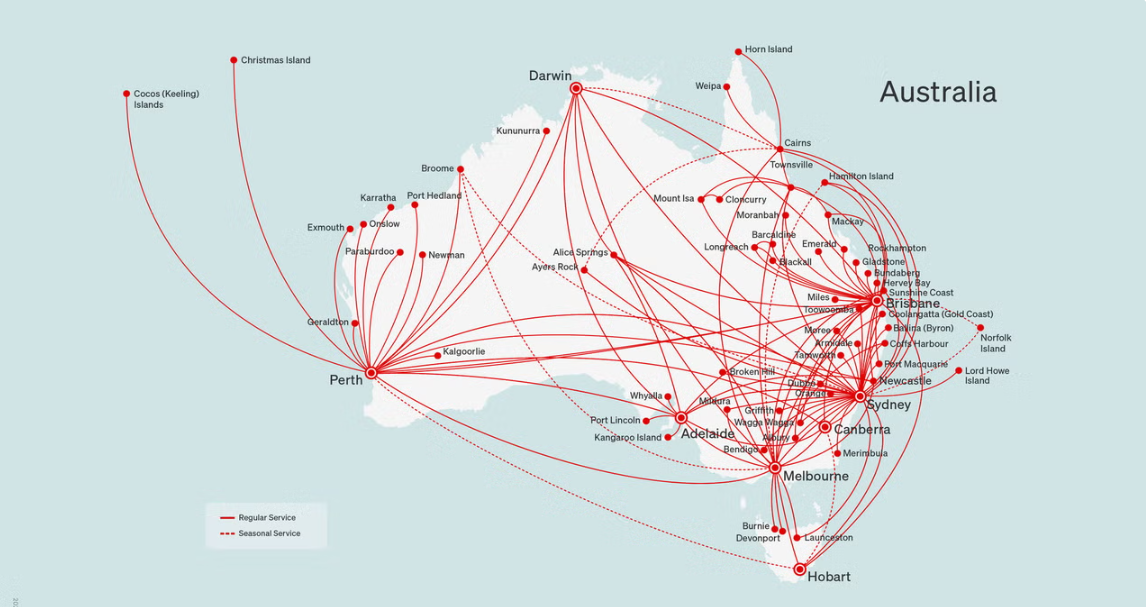
Qantas’ international network:
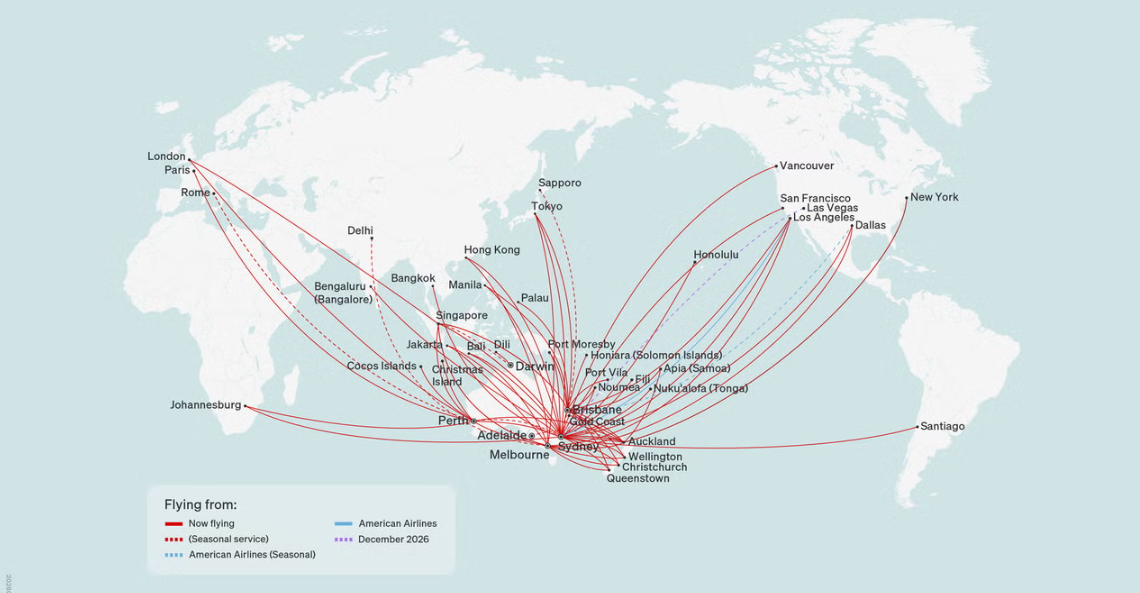
Qantas offers access to 35 destinations in 31 countries across 5 continents:
Asia: The Natural Gateway

Asia accounts for the largest volume of Qantas’ international flights. Singapore is the main transit hub for Southeast Asia and Europe (via partner airlines). Tokyo (Narita and Haneda), Hong Kong, Shanghai, Beijing, Bangkok, Jakarta, Denpasar (Bali), Osaka, and Manila are part of the regular network. The Sydney–Singapore route is operated several times a day with direct service and serves as a key connection point to Europe via Singapore Airlines or Qantas connecting flights to London (until the launch of Project Sunrise via the direct flight).
Europe: The Longest Trip

With the launch of Project Sunrise, Qantas flights to Europe now include a stopover. Sydney and Melbourne are connected to London Heathrow via codeshare and direct flights through Singapore (with Singapore Airlines) or Dubai (with Emirates). Rome Fiumicino is also served from Perth via a seasonal direct service, a route that Qantas operates with its Boeing 787 Dreamliner. Paris, Frankfurt, and Amsterdam are accessible via oneworld partners (British Airways, Iberia, Finnair, Air France, KLM).
The Americas: Los Angeles, Dallas and New York

The United States is served daily via Los Angeles (the main hub for connections to the East Coast), San Francisco, and Dallas-Fort Worth (on a codeshare with American Airlines). Seasonal flights to other U.S. cities are regularly added based on demand. Canada (Vancouver, Toronto) is accessible via oneworld partners, with no direct Qantas flights. The nonstop flight from Sydney to New York is being launched as part of the Sunrise project.
The Pacific: The ultimate vacation destination

Bali, the Maldives, Fiji, Phuket, Ho Chi Minh City… beach destinations in the Pacific and Southeast Asia are very popular with Australian travelers. Qantas offers nonstop service to Fiji from Sydney and Melbourne and has partnered with Fiji Airways to expand its offerings in the South Pacific. New Zealand (Auckland, Wellington, Christchurch, Queenstown) is served daily by numerous nonstop flights from major Australian cities.
Trending destinations for Summer 2026: Where are australians heading?
As the cold sets in across Australia; in the midst of the Southern Hemisphere winter, which coincides with summer in the Northern Hemisphere; one thing never changes: the irresistible urge to escape to the sun. With winter school breaks in full swing and the Australian dollar holding steady, thousands of families and travelers are flooding the country’s airports to catch up with the summer that’s in full swing elsewhere on the planet. But where do Australians actually go in the summer? Between Bali, which remains the undisputed favorite; Japan, which is experiencing unprecedented popularity; and hidden gems like Malta and Croatia, which are skyrocketing in search trends, the 2026 trends paint a fascinating picture of Australians’ desire to get away. Here’s an overview of the destinations that are taking social media and travel blogs by storm this year:
- Bali (Indonesia): Still the No. 1 destination, accounting for about 14% of all Australian trips abroad, driven by its proximity, affordability, and reliability.
- Japan: Seeing very strong growth. An Australian eSIM provider notes that Japan has literally exploded in popularity this year, whereas just a few years ago it was mainly known for cherry blossom season and skiing in Niseko.
- New Zealand: Still a top choice for extreme sports in Queenstown, geothermal attractions in Rotorua, and the vineyards of Marlborough, with a strong trend toward RV vacations and road trips.
Destinations on the rise:
Malta has become the number one “trendy” destination for the Southern Hemisphere winter.
Milos and Athens (Greece), Seoul, Da Nang, and Ho Chi Minh City (Vietnam), Nice (France), Dubrovnik and Split (Croatia) are being touted as the rapidly rising “affordable Europe” alternative.
Book with flexibility:
For long-haul flights, compare direct Qantas flights with oneworld options via other hubs, fares can vary significantly depending on the date and chosen connection point. Flights to Europe via Dubai with Emirates tend to be competitive in Economy but impose high surcharges on award tickets. Travelers with flexible departure and arrival dates will generally find better options midweek. → Book your Qantas flight and compare fares.
A great opportunity to collect Qantas points
On both domestic and international flights, frequent flyer members can accumulate points and status credits. You can use the Qantas points calculator to find out how many points you can earn on your booking. → Learn also how to maximize your earnings with the Qantas Frequent Flyer Program.