
Understanding Qantas’ baggage policy and rules before packing can save you tens or even hundreds of dollars at the airport. The Australian airline’s policy is relatively generous compared to many international carriers—all passengers are entitled to at least one checked bag included; however, the details vary depending on the route, cabin class, and Frequent Flyer status. Here is a comprehensive and up-to-date guide.
Carry-on Baggage: What you can bring onboard
Qantas allocates a baggage allowance according to the fare and the type of flight.
On Australian domestic flights (excluding Dash 8 aircraft):
Each adult passenger may bring one main carry-on bag with a maximum total weight of 10 kg, with a second option available depending on the configuration. In addition, you may bring one personal item (handbag, laptop in a slim case, camera) that must fit under the seat in front of you. Qantas does not specify exact dimensions for the personal item but requires that it fit under the seat.
On international flights:
Passengers traveling in Economy may bring one carry-on bag weighing up to 7 kg or a soft garment bag, plus one personal item.
Passengers in Premium Economy, Business, and First Class enjoy a more generous allowance, of up to two pieces weighing 10 kg each on certain flight configurations.
On Dash 8 aircraft (QantasLink regional flights), the allowance is limited to a single carry-on bag weighing up to 7 kg and measuring no more than 48 × 34 × 23 cm. There are no exceptions for personal items exceeding this weight limit.
Rules on batteries and electronic devices:
Qantas has recently tightened its rules regarding lithium batteries. Each passenger may carry a maximum of two external batteries (power banks) in carry-on luggage only, with each battery not exceeding 160 Wh. On board, batteries must remain easily accessible (in the seat pocket or under the seat in front of you) and may not be used or recharged during the flight. Batteries exceeding 160 Wh are prohibited on all Qantas passenger flights without exception.
Checked Baggage: Allowances by Cabin Class and Route
Australian domestic flights:
– Economy Class: 1 piece of 23 kg included;
– Business Class: 2 pieces of 32 kg each. No single piece may exceed 32 kg or 140 cm in total dimensions (length + width + height). On Dash 8 aircraft, the limit is set at 1 piece of 23 kg only.
International flights (excluding the Americas)
– Economy Class: 30 kg total weight, divided among as many pieces as desired, with no single piece exceeding 32 kg or 158 cm.
– Premium Economy and Business Class: 40 kg.
– First Class: 50 kg. Gold Frequent Flyer members are eligible for up to 46 kg in Economy; Platinum and Platinum One members are eligible for up to 50 kg.
Flights to and from the Americas:
The system is based on the number of pieces rather than total weight.
- In Economy Class: 1 piece weighing up to 32 kg
- Premium Economy: 2 pieces weighing up to 32 kg each.
- Business and First Class: 3 pieces weighing up to 32 kg each.
Frequent Flyer status may increase this allowance to 4 pieces for Gold members and above in premium cabins.
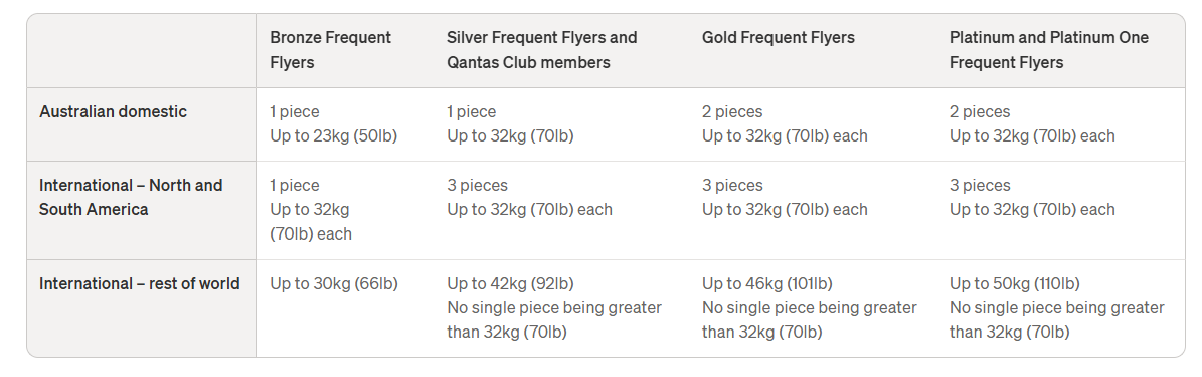
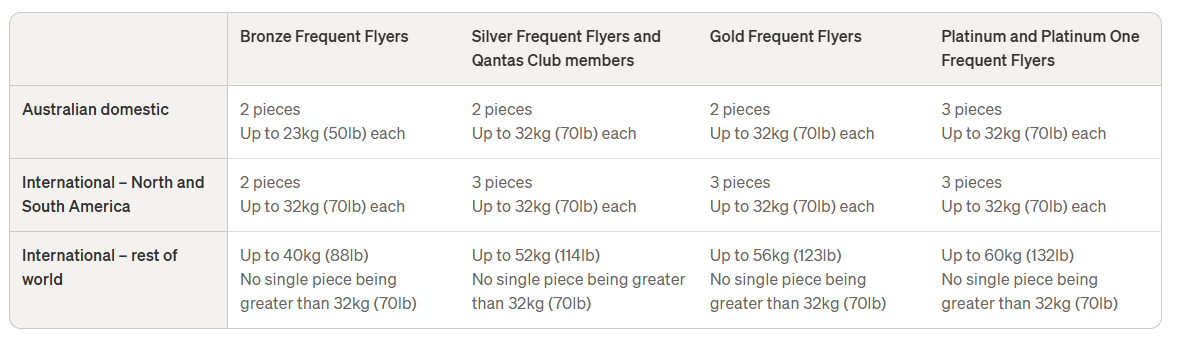
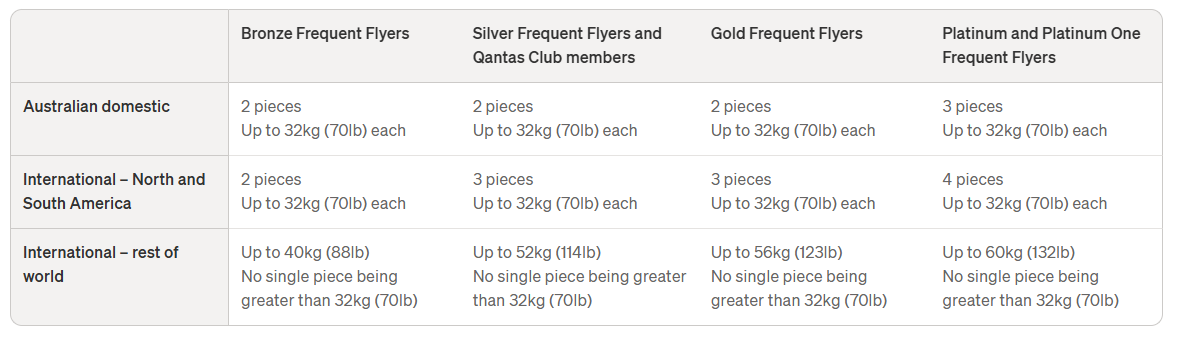
Baggage allowances for Qantas domestic and international flights, based on Frequent Flyer program status:
– Economy Class:
– Premium Economy:
– Business Class:
– First Class:
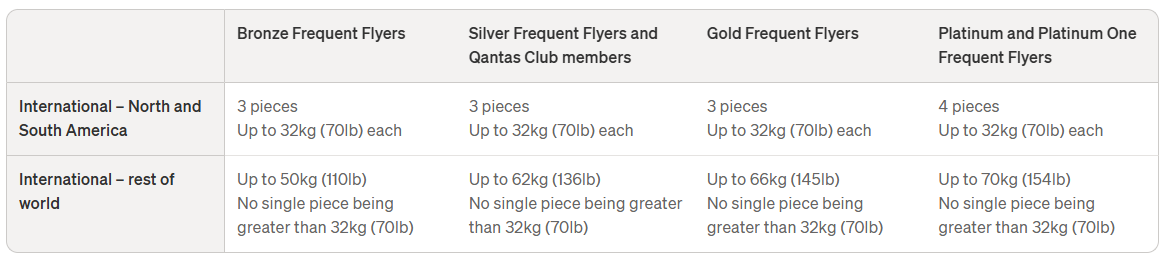
Important: An overall limit of 65 kg per person applies to all checked baggage (including the free allowance and any pre-purchased additional bags), regardless of status or class of service.
Special baggage allowance on Qantas flights operated by Dash 8
Due to the smaller size of the Dash 8 aircraft used exclusively on Qantas domestic flights and certain regional flights—such as those to Devonport, Dubbo, Kangaroo Island, Longreach, and Mildura (generally operated under the QantasLink brand)—Qantas applies a different baggage policy:
– Carry-on baggage: Only one piece of carry-on baggage is allowed, weighing up to 7 kg (15 lb) and measuring up to 105 cm (41 in).
– Checked baggage: Only one piece of checked baggage weighing up to 23 kg (50 lb) is allowed.
Additional baggage allowances associated with Frequent Flyer status or Qantas Club membership do not apply.
Surfboards are limited to 240 cm.
Exception to the rule:
Flights to Lord Howe Island are exempt from this rule: Passengers may check two pieces of baggage with a combined total weight of 23 kg, or one piece weighing up to 14 kg and a second piece weighing 9 kg.For flights to and from Christmas Island and the Cocos (Keeling) Islands, the standard baggage allowance applies.
Unaccompanied Baggage (Connecting Flights):
When your itinerary combines a domestic Qantas flight and an international Qantas flight on the same ticket, the international baggage allowance applies to both segments. If the flights are on separate tickets, the international baggage allowance also applies if the connection is on the same calendar day. Present both tickets at check-in to take advantage of this rule. If in doubt, check your baggage allowance directly in the “Manage My Booking” section after logging in.
What is Qantas’s baggage allowance for infants and children?
Qantas does have specific baggage rules based on the child’s age group.
Infants (under 2 years old):
There is no separate carry-on allowance for infants; the accompanying adult may simply bring an additional bag (diapers, food) in addition to their own carry-on allowance.
There is no standard checked baggage allowance, but three free child items are always included: for example, a collapsible stroller, a car seat, or a portable bassinet/crib.
On international flights to/from the Americas: one item up to 115 cm and 10 kg is allowed in addition to the three items
Children (ages 2–11):
– Same carry-on and checked baggage allowances as an adult
– Plus two additional free child items (e.g., car seat, stroller, portable crib)
Important points to remember:
A child aged 2 or older requires their own seat and ticket (unlike an infant, who may travel on an adult’s lap)
Strollers are not permitted in the cabin or as “gate-check” baggage on Dash 8 or Embraer E190 flights, they must be checked as hold baggage on these aircraft.
Infant bassinets are available on certain international flights (B787, A380, A330) and on some domestic routes (A330), upon prior request and subject to availability.
Buying extra baggage: How much does it cost?
The golden rule is simple: buy your extra baggage on qantas.com before you arrive at the airport. The price difference between buying online and paying at the counter can be as much as double. On domestic flights, an extra bag costs about 64 to 161 A$ online. On international flights, rates depend on the route and the additional weight requested (Until 315 A$ for each extra piece). You can also use your Qantas Points to purchase additional baggage; expect to use about 6,000 points per domestic bag. → Learn how to use your Qantas Points.
Excess baggage fees (per piece) charged by Qantas based on the itinerary:
North → South America: A$315
North → South America: USD 210
Excess baggage fees (per kilogram):
Australia ⇄ Fiji, New Caledonia, New Zealand, Papua New Guinea, Samoa, and Tonga: A$21/kg
Australia ⇄ Asia: A$37/kg
Asia ⇄ UK ⇄ Europe: A$63/kg
Australia ⇄ Europe ⇄ South Africa ⇄ UK: A$84/kg.
Qantas Special Baggage Policy:
– Sports equipment
Sports equipment and other oversized items count toward your checked baggage allowance.
Surfboards longer than 277 cm (240 cm on Dash 8 aircraft) must be shipped as cargo—cargo rates apply. For golf, ski, or scuba diving equipment, see the detailed rules for transporting sports equipment.
– Medical Equipment:
Passengers who require medical equipment to travel safely (such as respiratory devices) must obtain approval from Qantas Specific Needs prior to departure. Qantas publishes a list of approved medical equipment. On domestic flights, any medical device used on board must be battery-powered.
Equipment for passengers with reduced mobility includes both mobility aids (manual or electric wheelchairs, electric scooters). and assistive devices (walkers, patient lifts, inflatable compression cushions, shower chairs, commode chairs).
Carrying medical equipment in the cabin (folding wheelchairs only): On international flights operated by Airbus A380 and Boeing 787 aircraft, only one personal foldable manual wheelchair (in total, not per passenger) may be stored in a designated space in the cabin. The permitted dimensions are 33 cm x 91 cm x 106 cm when folded, with a maximum weight of 30.9 kg. This space is allocated at the time of check-in at the airport on a first-come, first-served basis.
If the equipment does not meet these criteria; including motorized wheelchairs; or if the designated space is already occupied, it will be stowed in the cargo hold. On all other aircraft types and routes, personal wheelchairs cannot be brought into the cabin.
Canes, crutches, and walkers: Canes and crutches may be used up to the boarding gate and then stowed on board in an overhead compartment or another storage area. A foldable walker may also be stored in the cabin if the flight crew can stow it safely; however, a non-foldable walker is not permitted in the cabin for safety reasons and must be checked as baggage—in which case the passenger will be transferred to a Qantas wheelchair at the boarding gate.
Battery-powered equipment: Any battery-powered wheelchair or scooter must obtain “dangerous goods” approval from Qantas prior to travel, including information on the battery type (a safety data sheet and a certificate of compliance are required for lithium-ion batteries).
Insurance and liability: Although Qantas takes all reasonable precautions, the passenger remains responsible for obtaining insurance covering the transport of their mobility equipment.
Recommended Notice Period: It is strongly recommended that you notify Qantas at least 48 hours before your flight if you are traveling with your own mobility equipment, as failure to do so may result in delays in handling.
In case of damage: A claim can be submitted via the dedicated customer service form, in the section for damaged mobility equipment.
Free allowance:
Two pieces of mobility equipment per person are transported free of charge in the cargo hold, in addition to your standard baggage allowance. Each piece must not exceed 32 kg, unless the equipment can be moved in an upright position and roll freely. Items weighing more than 32 kg that cannot be moved freely in an upright position must be shipped as cargo at standard rates. This equipment must be for your own personal use.
If you wish to check more than two pieces of mobility equipment, the additional pieces will be counted toward your standard baggage allowance and may incur fees.
Special case for flights to/from the United States: On these flights, there is no limit to the number of mobility aids a passenger with a disability may carry, and these do not count toward either the carry-on baggage allowance or the checked baggage allowance.
A few important points to remember:
– You may bring your device as an additional standard carry-on bag at no extra charge, provided it meets the weight and size limits for carry-on baggage.
– Hearing aids and pacemakers are permitted without any specific restrictions. Contact Qantas Customer Service for more information.
– Equipment intended for use on board must be presented for inspection a few hours before departure to be approved.
– Authorizations and clearances must be provided to Qantas up to 72 hours before the flight.
– Passengers must provide all medical equipment necessary for safe travel themselves, and it is recommended that medications be carried in carry-on baggage.
– For CPAP/PAP devices (sleep apnea), no prior approval is required, but Qantas recommends traveling with a letter from a healthcare professional justifying the need for the device. If supplemental oxygen is required (portable concentrator or cylinder), a medical clearance form must be completed.
– Lithium batteries exceeding 160Wh are prohibited on all Qantas aircraft, whether built-in or used as backup batteries.
In the event of lost, damaged, or delayed baggage:
If you encounter a problem with your baggage upon arrival, report it immediately to the Qantas baggage counter before leaving the airport. You will be given a PIR (Property Irregularity Report); keep it in a safe place in case you need to file a claim with Qantas or your travel insurance provider. The Montreal Convention sets the maximum compensation amounts for loss or damage. For delayed baggage, Qantas may reimburse certain emergency expenses upon presentation of receipts.
FAQs about Qantas’ baggage policy:
Q: Is there a total weight limit per person?
A: Yes. An overall limit of 65 kg per passenger applies, which includes both the included allowance and any additional baggage purchased. This rule applies to both standard travelers and Qantas Frequent Flyer and Qantas Club members.