
Choosing your seat before boarding is often the difference between a relaxing flight and a never ending one stuck in the middle, next to the restroom. At Qantas, the seat selection system is more nuanced than it seems: it depends on your loyalty status, when you book, and even the aircraft you’re flying on. Here’s a comprehensive guide to understanding how the system works and finding the best seats.
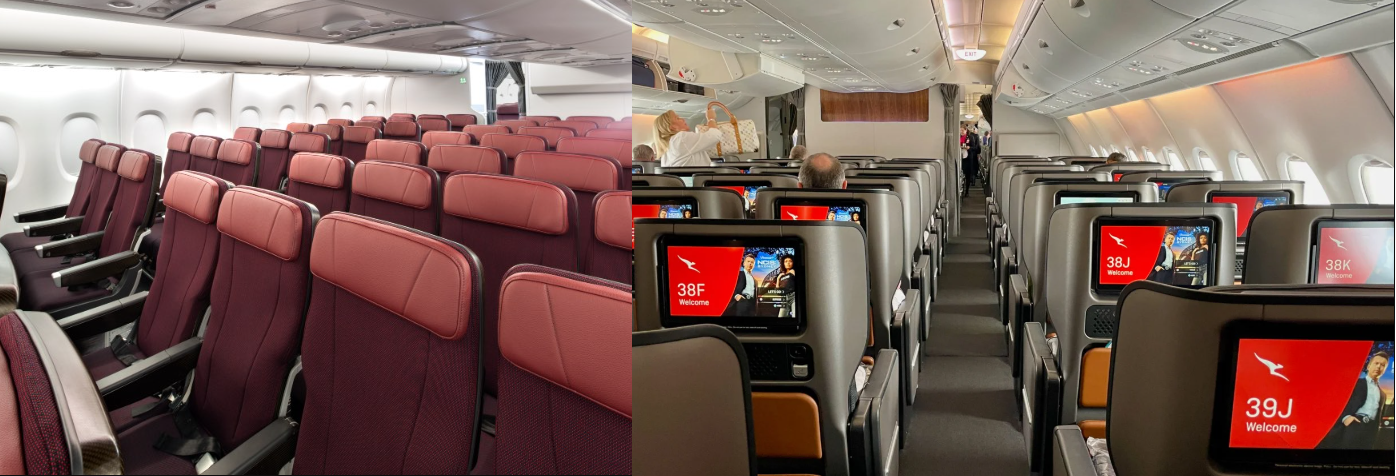
How seat selection works at Qantas
On flights operated by Qantas (international flights QF1 through QF199 and domestic flights QF400 through QF1349), you can choose your seat when booking online, or at any time before departure via the “Manage My Booking” section. On regional routes operated by QantasLink, however, you can generally only indicate a preference (aisle or window), with no guarantee.
One key point to understand: not everyone has access to seats at the same time. Qantas reserves certain areas of the cabin—particularly the first few rows—for the most loyal members of its Qantas Frequent Flyer program. A Platinum One or Chairman’s Lounge member can choose any seat for free as soon as the ticket is purchased, while a passenger with no status or Bronze status will only have access to standard seats, and often later in the process.
The T-80 and T-24 rules
This is the most sought-after tip among frequent Qantas travelers.
– T-80 (80 hours before departure): At this point, some of the seats previously reserved for Platinum and Gold members become available to all passengers, subject to availability. It’s therefore advisable to check the cabin layout again about 80 hours before the flight, as better seats may suddenly become available.
– T-24 (24 hours before departure, when check-in opens): Additional seats become available for free, sometimes including coveted front rows such as row 4 on domestic Boeing 737s.
In practice, many travelers reserve a decent seat as soon as they purchase their ticket, then set a reminder to check the cabin layout again at T-80 and T-24, hoping to move up a few rows at no extra cost.
The different types of seats offered on Qantas flights:
Before booking, it’s helpful to know what the categories listed on the Qantas website entail:
– Standard seats: included in most Economy fares; selection is free depending on your loyalty status and the time of booking.
– Economy Plus / Forward Seats: Located at the front of the Economy cabin, these seats allow for faster boarding and deplaning. Free access depends on your Frequent Flyer status.
– Extra Legroom Seats: Often located near emergency exits, these seats offer several centimeters of extra legroom. There is a fee for these seats (generally between 35 and 200 AUD, depending on the flight length), except for Platinum One and Chairman’s Lounge members. They are subject to strict conditions: passengers must be at least 15 years old and physically capable of assisting the crew in the event of an evacuation.
– Seats with bassinet (baby crib): reserved for families traveling with an infant, generally located in the first row of the cabin and intentionally kept out of the general seat selection until shortly before departure.
How to reserve a specific Qantas seat
– At the time of ticket purchase: The cabin layout is displayed directly during the booking process. This is when you have the widest selection.
– Via “Manage My Booking”: Once your ticket is purchased, log in to qantas.com or the mobile app, find your booking using your booking reference (PNR) and name, then access the seat map.
– During online check-in (24 hours before departure): Check-in opens 24 hours before departure. This is the time to double-check if any better seats have become available for free.
– At the airport: as a last resort, the staff at the check-in counter can still change your seat depending on availability, particularly for QantasLink flights where online seat selection is limited.
Please note: If you’re traveling as a group but have separate reservations, each of you will need to select your own seat. Qantas cannot combine two separate reservations, so you’ll need to manually select seats next to each other, ideally as early as possible.
What are the best seats depending on the aircraft?
Frequent flyers on Qantas long-haul flights agree on a few key points:
– Boeing 737-800 (domestic flights): Row 4 is the most sought-after for its legroom, but it’s now often classified as a paid seat. Avoid: the rear of the cabin, near the restrooms and galley, as well as seats 9A or 10A, which have no window (just the wall).
– Airbus A330: The emergency exit rows remain the best balance of space and price in Economy. The rear of the cabin, which is longer on the A330-300, means a longer walk to the forward restrooms and more engine noise.
– Boeing 787-9 Dreamliner: On long-haul routes like Perth–London, emergency exit rows are the best choice in Economy, and the electrochromic window (which darkens without a curtain) is a real plus. Avoid: the rear of the cabin, near the rear galley and kitchen odors.
– Airbus A380: In Economy Plus/Premium Economy, the rows near the emergency exits (such as row 31) offer the most space. The seats in the middle section, without a window or aisle, remain the least comfortable on a long flight.
Online seat mapping tools (alternatives that have replaced SeatGuru, such as AeroLOPA or specialized comparison sites) allow you to view the exact layout of each aircraft before making your selection.
Fees to expect when selecting a Seat on a Qantas flight:
The fee for a seat with extra legroom varies significantly depending on the flight distance: approximately 15 to 35 AUD on a short domestic flight, and up to 195 ~ 200 AUD on longer international routes (United Kingdom, Europe, the Americas, South Africa). These fees can also be paid with Qantas Frequent Flyer points, but not in combination with a partial cash payment.
If you are upgraded after paying for a seat with extra legroom, the amount paid for the seat selection is generally not automatically refunded—a point frequently cited as a source of frustration on frequent flyer forums.
FAQ:
Q: Does Qantas offer refunds for cancellations made within 24 hours of purchase?
A: In most cases, yes: if you cancel your reservation within 24 hours of purchase, you can generally receive a full refund, provided the flight’s departure is still far enough in the future. This flexible policy applies primarily to bookings made directly on the Qantas website or app. We recommend checking the specific fare conditions associated with your ticket before clicking “Cancel.”
Q: Are all Qantas tickets refundable?
A: No. Eligibility for a refund depends entirely on the type of fare purchased. Some promotional or basic economy fares are non-refundable and can only be rebooked (sometimes with a fee), while flexible fares or tickets in higher classes offer greater refund flexibility. You should therefore always review the fare conditions displayed at the time of booking.
Q: How long does it take to receive a Qantas refund?
A: Qantas states that it processes the vast majority of its refund requests within about a week, with refunds being processed in the order in which requests are submitted. The actual time it takes to receive the refund depends on the original payment method and the processing times of your bank or card issuer: some passengers report receiving a credit within a few days, while others wait several weeks. If you haven’t received a refund after about four weeks, we recommend contacting Qantas customer service directly to follow up on your request.
Q: How do I request a refund from Qantas?
A: The process is primarily handled online via the refund request form available on the official Qantas website, which you can access from your booking under “Manage My Booking.” You can also contact customer service by phone. Always keep proof of purchase (invoice, booking confirmation, or credit card statement), as you may be asked to provide it to process your claim.
Q: What happens if Qantas cancels or delays my flight?
A: If the cancellation or significant delay occurs within 72 hours of the scheduled departure, Qantas will rebook you on the next available flight that suits your needs, free of charge. You also have the option to request a refund instead of a new flight. On Australian domestic flights and international flights departing from Australia, additional assistance (meals, accommodations as appropriate) may be provided when the disruption is the airline’s fault. Specific rules apply depending on the geographic region: Australian consumer law, Canadian air passenger protection regulations, or European and UK regulations applicable to flights of more than 3,500 km departing from the EU or the United Kingdom.
Q: Can I get a refund if I cannot travel due to a medical condition or a death in the family?
A: This depends on your ticket’s fare rules, but Qantas generally reviews these types of situations on a case-by-case basis, particularly for exceptional circumstances (serious illness, death of a close relative). Proof (such as a medical certificate or death certificate) is usually required. This is not an automatic right included in all fare rules: the decision remains at the airline’s discretion depending on the type of ticket.
Q: What happens to the money if my ticket is nonrefundable?
A: For a non-refundable ticket, cancellation usually results in a travel credit (to be used on a future reservation within a specified time frame) rather than a cash refund, except in exceptional circumstances or if the cancellation is initiated by the airline. It is important to check the expiration date of the credit, as it may expire.
Q: Are seat selection fees refunded in the event of a cancellation or upgrade?
A: If your trip is fully canceled in accordance with the applicable fare rules, seat selection fees generally follow the same treatment as the ticket. However, if you voluntarily change your flight or are upgraded (particularly through a points redemption), the amount paid for the seat selection is generally not automatically refunded: it’s best to contact customer service to clarify your situation before giving up the paid seat.
Q: Can a Qantas refund be requested for a ticket purchased through a travel agency or a third party?
A: Yes, but the process generally goes through the agency or platform used for the purchase rather than directly through Qantas, since that intermediary holds the original transaction. The processing times and conditions may therefore differ from those applied to bookings made directly on qantas.com.