
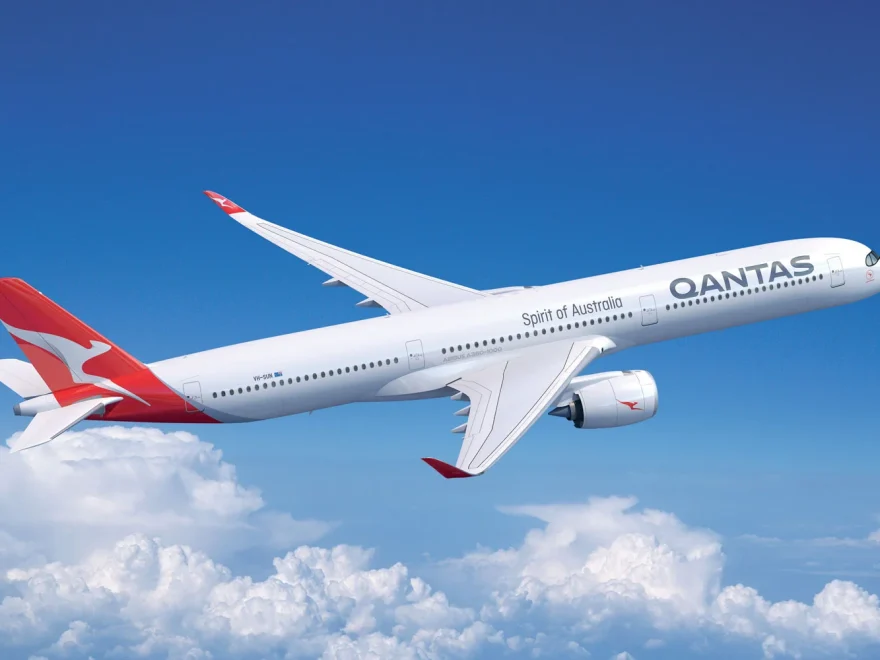
After a nine-year wait, the Australian airline Qantas has finally made official the news its passengers have been eagerly awaiting: a nonstop flight from Sydney to London. This technological and human challenge is set to redefine long-haul aviation.
A promise kept after nearly a decade:
Announced nearly nine years ago, Qantas’ “Project Sunrise”—aimed at connecting Australia’s east coast directly to London and New York—has faced numerous setbacks, particularly due to the onset of the pandemic and the financial difficulties it caused for the Australian airline.
But Qantas is finally keeping its promise by confirming that the Sydney-London flight will launch in October 2027, marking what will become the world’s longest nonstop commercial flight, with an estimated duration of between 19 and 22 hours.
Qantas Group CEO Vanessa Hudson said during her visit to the Airbus plant in Toulouse, where the first aircraft built for this historic route was being painted in the airline’s red and white colors: “Qantas was founded on the belief that Australia’s distance from the rest of the world should never be a barrier.”
An Airbus A350 with extra fuel capacity:
To meet this historic challenge, Qantas is relying on a special version of the Airbus A350-1000 that has undergone a major modification. Qantas’s new wide-body aircraft will be equipped with an additional central fuel tank capable of carrying 20,000 liters of extra fuel, bringing the total capacity to 168,000 liters. This allows the aircraft to fly more than 16,000 km nonstop for up to 22 hours.
By comparison, the longest commercial flight currently in service is operated by Singapore Airlines, covering a distance of 15,349 km in 19 hours.
It should be noted that Qantas has placed an order with Airbus for the delivery of 12 aircraft to operate on the Sydney-London and Sydney-New York routes. The first aircraft is expected to be delivered in April 2027. Tickets will go on sale in February of next year.
The A350-1000: A Cabin Designed for Passenger Well-Being:
Convincing passengers to stay on board for nearly an entire day is the real commercial challenge of Qantas’ Sunrise project, so the airline has completely reimagined the in-flight experience. Every element has been designed to help passengers arrive at their destination feeling refreshed.
The A350-1000 operated by Qantas on its new flight carries only 238 passengers across four classes: 6 First Class Suites, 52 Business Class Suites, 40 Premium Economy seats, and 140 Economy Class seats ; the lowest seat density ever configured on any A350.
In First and Business Class: each First Class suite features a two-meter flat bed and a separate reclining armchair. The Business Class suites are equipped with a two-meter bed and, for the first time, include a sliding door to ensure maximum privacy for passengers.
The Eco Premium cabin will be equipped with seats featuring a multi-layer memory foam system and woven linen upholstery with ochre hues inspired by Australia. They offer more legroom than any other aircraft currently in the Qantas fleet.
– The flagship innovation: The Wellbeing Zone
Qantas will be the first airline in the world to offer an onboard wellbeing zone, located between the Premium Economy and Economy cabins. This space features sculpted panels with fully integrated handholds, as well as an on-screen guided exercise program and a hydration station.