
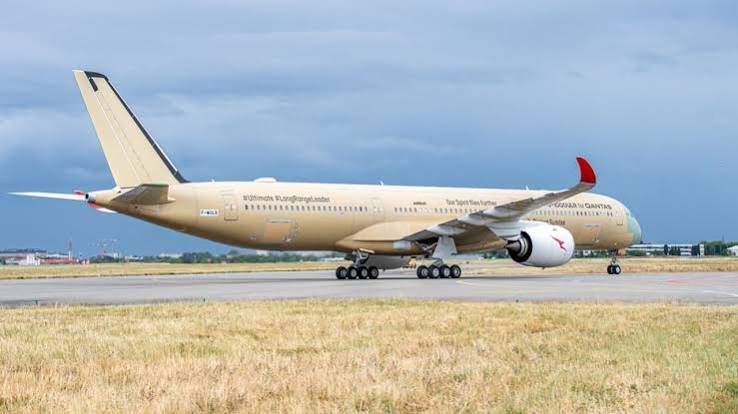
A historic milestone has just been reached in the adventure of the ultimate long-haul flight. The very first Airbus A350-1000ULR, the ultra-long range version designed specifically for Qantas has flown to Australia nonstop at the end of an extraordinary test flight. The aircraft departed France to reach Melbourne.
A marathon flight over three continents
Airbus’s first ultra-long-range A350-1000ULR landed in Melbourne at the end of a nonstop test flight departing from Toulouse, lasting approximately 19 hours and 11 minutes. The aircraft, identified by the call sign “Airbus 35LR,” carried out an instrument approach before touching down on runway 27 on July 24, at around 10:45 a.m. local time. Developed for Australian carrier Qantas’s Project Sunrise initiative, the aircraft had taken off from runway 32L at Toulouse-Blagnac the previous day, at 7:34 a.m. French time.
Its flight path took it over Italy and the Mediterranean, then Egypt and Saudi Arabia, before it crossed the Indian Ocean level with Sri Lanka to reach Australia, reaching a maximum altitude of 41,000 feet.
Nine people were on board: four test pilots and five Airbus engineers, tasked with operating all of the aircraft’s systems, starting with its additional fuel tank installed at the rear of the fuselage. Two Qantas pilots are due to join the crew on the return flight to Toulouse, scheduled for July 27.
An aircraft built for extremes
The A350-1000ULR (for Ultra Long Range) differs from the standard version through an additional 20,000-liter central tank, installed at the rear of the aircraft, which theoretically allows it to fly nonstop for up to 22 hours. Its range reaches around 18,000 kilometers, enough to connect Australia’s east coast directly with Europe or the east coast of the United States.
Goal: Sydney-London nonstop by the end of 2027
This test flight is part of a certification campaign expected to total between 75 and 80 flight hours before the aircraft can enter commercial service. Qantas is targeting the launch of its first Project Sunrise routes for October 2027, initially with a Sydney-London route, followed later by a connection to New York.
The first example to leave the ground, the test aircraft carries the provisional registration F-WULR and serial number MSN707. It made its first flight on June 2, 2026, before going on to complete ground and flight testing in Toulouse, particularly on its completely redesigned fuel system. A second example, this one already painted in Qantas livery and named Vega, is currently taking shape on Airbus’s final assembly line: it will be the first Project Sunrise aircraft delivered to the Australian carrier, in April 2027.
Comfort at the heart of Project Sunrise
Flying for more than 19 hours straight poses as many challenges for passengers as for the aircraft itself. Qantas has designed a reduced-density cabin with just 238 seats spread across four classes, including a dedicated wellness zone and lighting modeled on circadian rhythms, designed to limit fatigue and jet lag on these extraordinary flights. The airline is banking on this level of comfort to justify a premium offering, relying on the considerable time savings compared to current routes, all of which require a stopover.