
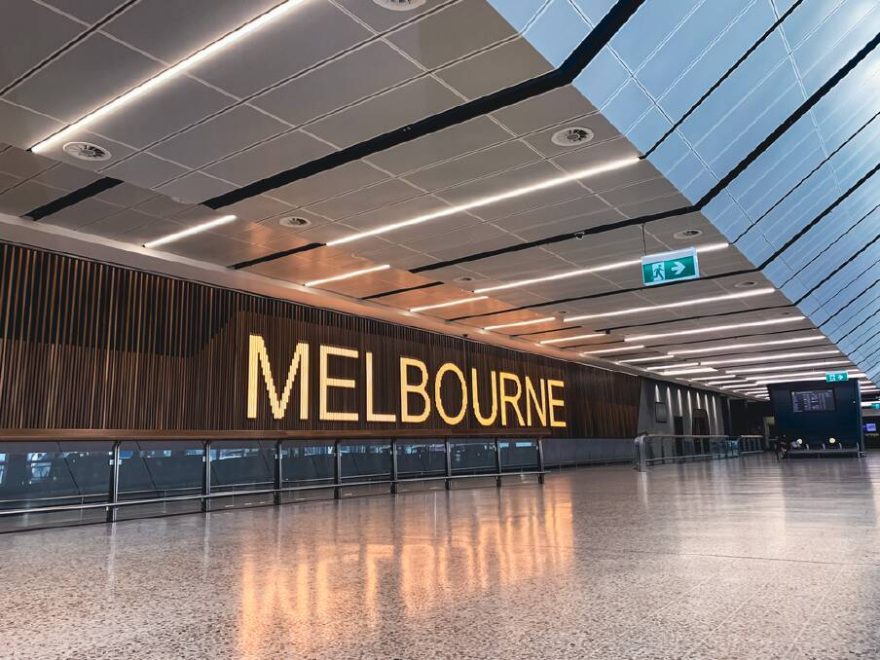
Melbourne Airport (Tullamarine) is about to undergo a major transformation. The mega-project, estimated at 4.5 billion Australian dollars, involves the expansion of the international terminal: five new gates for wide-body aircraft, a modernized check-in area with automated baggage drop-off, expanded waiting areas, and a state-of-the-art baggage tracking system.
At the same time, a third runway (named M3R), 3,000 meters long, is under construction to accommodate wide-body aircraft such as the A350-1000. Construction officially began in early 2026, with an opening scheduled for 2031, to put an end to the delays caused by the current intersecting runway system.
The Qantas & Melbourne airport partnership
In this context, the Qantas Group and Melbourne Airport recently announced a major commercial agreement. Unlike a “direct takeover of construction,” this is a 15-year commitment by Qantas to support the delivery of Melbourne Airport’s third runway, with funding still provided by the airport (Australia Pacific Airports Corporation). This agreement is also intended to support the international terminal expansion program, including five new wide-body gates.
The agreement also calls for the construction of a new Qantas Business international lounge-up to one-third larger than the current one – which is scheduled for completion in 2029.
Lorie Argus, CEO of Melbourne Airport, said: “We are proud to be Australia’s largest 24-hour gateway, and delighted to partner with Qantas to deliver the most significant modernization in our airport’s history.”
For his part, Rob Marcolina, Chief Financial Officer of the Qantas Group, announced:
“This will unlock growth for both Qantas and Melbourne Airport and enhance the travel experience for millions of our customers each year. From check-in to our lounge to our new fleet, we’re investing across all areas of our business to transform the way our customers travel to and from Melbourne.”
A Role for Melbourne in Qantas’ Sunrise Project?
The recent test flight for Qantas’ Sunrise project has indeed put Melbourne in the spotlight: on July 24, 2026, the Airbus A350-1000ULR, registration F-WULR, landed at Melbourne Airport after a nonstop flight of 19 hours and 11 minutes from Toulouse-Blagnac. A few days later, the same aircraft achieved an even more spectacular feat by flying from Melbourne to Toulouse in 24 hours and 24 minutes, via a trans-Pacific route passing over the western United States, eastern Canada, and southern Greenland. These test flights thus confirm that Melbourne’s airport infrastructure is technically capable of supporting this type of operation.